As the Fourth Industrial Revolution brings advances in fields such as AI, IoT, Big Data, Blockchain and robotics, certain industries have responded quickly, while others have been able to carry on without radical change. The Transportation & Logistics (T&L) industry has introduced innovation and technology at a much slower pace than other sectors, but that is changing, and it is changing now.
Having the right product at the right time at the right place and in the right condition – these are the well-known requirements for logistics and transportation in general. But fulfilling these requirements is getting more and more complex in a dynamically changing logistic environment. There is a shift from traditional supply chains to open supply networks. Long-lasting business relationships are overrun by short-term business connections. The highly dynamic logistic markets and the advancing complexity of logistic networks require new methods, products and services. Aspects such as flexibility, adaptability and proactivity gain importance and can only be achieved by integration of new technologies. While problem initiated approaches usually only lead to minor improvements, technology driven approaches can evoke more radical changes. The technology driven approach that is used to define Smart Products and Smart Services is utilized and extended to define “Smart Logistics”

During the last decade, the use and evolution of Information and Communication Technologies (ICT) in industry have become unavoidable. The emergence of the Industry Internet of Things (IIoT) promoted new challenges in logistic domain, which might require technological changes such as: high need for transparency (supply chain visibility); integrity control (right products, at the right time, place, quantity condition and at the right cost) in the supply chains. These evolvements introduce the concept of Logistics 4.0.
Logistics 4.0: How smart technologies are lifting logistics to another level
After a period of exploration, OEMs, tier suppliers and logistics providers are getting serious about making their operations smarter and more connected – Logistics 4.0 is here
In recent years, Logistics 4.0 technologies have emerged as increasingly important tools in the automotive logistics sector, with a growing number of OEMs, tier suppliers and logistics providers exploring the potential benefits of their deployment: improved operational efficiency, accuracy and visibility, optimised inventory management and enhanced human workforce capabilities.
Logistics 4.0 enables process improvements through a variety of technological innovations, including smart robotics, driverless transport vehicles and automated systems for handling parts inside warehouses and factories. Logistics 4.0 does not only consist of technology or digital applications but represents “a new way of supply chain management, where client processes and stakeholders are fully connected to each other, with the final aim of giving an answer in an agile and easy way to every new business model that appears.
Automation is not enough… The visualisation of all the data of the whole supply chain and the use of predictive and cognitive analytics is the last step that will push us to the next level.
With the help of the Internet of Things (IoT) – the networked connection of physical objects to enable real-time data visualisation – and the automation of logistics flows. For outbound processes, RFID has helped the customers to automate its loading validation processes, increasing the productivity and efficiency of its compounds.
Automation of the in-house [processes] is already a reality. “But automation is not enough. To be fast and agile, it is essential to get full control of the supply chain. The visualisation of all the data of the whole supply chain and the use of predictive and cognitive analytics is the last step that will push industry to the next level.
What hardware and software underpins these Logistics 4.0 applications?
Advanced tools for localisation and identification like smart sensors and optical recognition will help us increase the transparency within our plant but also in our supply chain. Once it is possible to track every single piece of material from supplier to assembly, it is much easier to identify process bottlenecks and optimise the material flow. The general challenge is not so much on a technical level but much more a matter of common standards and open protocols for the whole industry.
What are the key benefits of Logistics 4.0 applications?
Automotive logistics has become one of the most complex logistics businesses. To satisfy our customers’ needs, we have to provide hundreds of thousands of different variants and part numbers at the right time in the right order at the right place. This is how automation can help our staff to increase efficiency and prevent errors while walking, reading and identifying part numbers or crosschecking information. This enables us to focus on those manual value-added processes which are too complex to be done by a machine.
What are the limits of Logistics 4.0 technologies right now?
One of the biggest limitations at the moment is the cost of technology investment. At the moment, many automation projects can only be realised in an economically successful way at sites with higher labour costs. But in the next years, we expect a strong decrease of hardware and software prices.
Economies of scale will apply, with an increasing number of automation projects until 2025. Today we might have an automation degree of 20%; for the next seven to ten years it is expected to grow up to 70 to 80%. Besides the increasing number of ‘regular’ automation [applications], we assume to also see a more intensive collaboration between human employees and robots working hand in hand.
Smart Logistics – The lay of the land
The supply chains of the future will be fully digitalised, facilitated by technology and standardised processes. Disruptive technologies will modify current logistics business models when limitations such as different technology standards and regulatory issues have been overcome.
As never seen before, technological innovation and customer demands for sophisticated technology and services promotes the emergence of new challenges, which is increasingly changing industry. This transformation will dramatically influence how organizations will be managed according to the new incentives, and environmental and context configuration. Although some sectors like automotive, technology and biology industry, through its commitment to overall efficiency and innovation, took the lead on the platoon of industry changes, others will have to follow the technological evolvement because this change is being done very quickly, allowing us to refer as the new Industrial revolution, commonly known as the fourth industrial revolution (Industry 4.0). This revolution is causing profound changes, not only in industry but also in society, in the economic rhythm and outlook, in how work is planned and operationalized, in what way should be oriented the human-machine interactions, among other situations. Although, the ability to correctly interpret and perceive these changes will allow us to gain a higher level of awareness and a capacity to monitor and read the markets, which will promote the organizational alignment with this pattern of paradigm change. Therefore, the gained sensibility will potentiate the interpretation of the clients’ behaviour towards choosing products and services, purchase vs. rental, as well as the appearance of new paradigms such as: shared economy, collaborative innovation, additive manufacturing, social networks, digital platforms among others that are contributing and enhancing the pace of change. During the last decade, the use and evolution of Information and Communication Technologies (ICT) in industry have become unavoidable, mainly by being vital for increasing the organizational efficiency and its level of competitively. This has promoted the adoption of ICT in most of the industry activities, but especially in logistics and production operations. This technological evolvement is evidenced by the well-known applications and highly used by most of organizations, such as Enterprise Resource Planning (ERP), Warehouse Management Systems (WMS), Transportation Management Systems (TMS), Intelligent Transportation Systems (ITS) . Nevertheless, the information availability in real time and in-line, gathered through VANET Systems, sensor networks, drone points and business intelligence systems, will increase the decision-making efficiency of management and become more and more flexible and efficient into the near future. In an Industry Internet of Things (IIoT) context the logistics challenges might require something like: high need for transparency (supply chain visibility); integrity control (right products, at the right time, place, quantity, condition and at the right cost) of the supply chain; dynamic ‘reconfigurability’ of supply networks, specially by re-examining service-level agreements with upstream and contracted suppliers; supply network design, towards achieving lean, agile, resilient and green supply chains . In this context, logistics will be addressed under the term of “Logistics 4.0”. In a technological and in-line processes perspective it must be noticed, the Logistics 4.0 aim is not to replace humans in their works, but to avoid inaccuracies and to have faster processes where the information can be shared effortless and in real time. It will be always needed the involvement of people controlling the processes and taking control of any system failure. In this paper, we intend to focus the discussion on some of the key challenges that will be needed to meet the requirements of the Logistics 4.0 era. This paper is organized as follows: In Section 2, we introduce an overview of Industry 4.0, its main features and its enabling technologies. In Section 3, we discuss the main implications and what are the basis of an efficient and strong Logistics 4.0, where Cyber-Physical System and technologies, are used to carry out activities, which are repetitive and automatic, with reduced human involvement.
Smart Logistics – Industry 4.0 overview
In general, Industry 4.0 encompasses the development and integration of innovative information and communication technologies into the industry. The main goal is to foster the intelligent networking of products and processes along the value chain, thus allowing it to use more efficiently the organizational processes, into the creation of goods and services to enhance customer benefit offering them novel products and services. These related changes in the industrial sector are seen as a comprehensive paradigm, currently named as the fourth industrial revolution: Industry 4.0. The first industrial revolution began with the development of the steam engine and the introduction of heavy mechanical manufacturing equipment. The second industrial revolution was characterized by the use of electricity, which allowed the use of the conveyor belt and the assembly line. The third industrial revolution brought the automation of production processes through the massive use of electronics and information and communication technologies. Lastly the evolvement of the cyber technologies and their integration into digital ecosystems of all industry value chain contributed to the emergence of the fourth industrial revolution, named “Industry 4.0”. The first reference to the Industry 4.0 was introduced at the Hannover Fair of Industrial Technologies, in 2011. Since then many companies started to develop solutions in compliance with the concept of Industry 4.0. Many governments are also supporting the development of such solutions, especially the European governments (with emphasis on the German government), the United States and the Japanese governments, confirming that this new Industry era is viewed as strategic by the major industrial powers and players. In general, the main purpose of the Industry 4.0 is the emergence of digital manufacturing, also named as “smart” factory, which means smart networking, mobility, flexibility of industrial operations and their interoperability, integration with customers and suppliers and in the adoption of innovative business models. The defining feature associated to the fourth industrial revolution is the intelligent networks based on cyber-physical systems. Cyber-physical systems (CPS) are physical and engineered systems, whose operations can be monitored, coordinated, controlled and integrated by a computing and communication system. CPS involves the interaction with the physical world and it is composed by a set of networked agents. These network agents include: sensors, actuators, control processing units, and communication devices (Fig. 1). The intensive use of the technological applications and the increase growth of wireless embedded sensors and actuators are contributing to the development of several new applications – in areas such as production processes, transportation system, logistics services, health services, autonomous vehicles, machine learning and smart structures– and consequently increasing the technological improvements of existing ones –such as Supervisory Control and Data Acquisition (SCADA) systems.
The “Internet of Things” (IoT), also known as “Industrial Internet of Things” (IIoT) has also affected the way CPS can interact, be monitored, be controlled and managed. Therefore, facilitate the integration of processes and systems across sectors and technologies and contributing to a better communication and cooperation with each other in a new intelligent way, revolutionizing production, services provision, logistics and resource planning in a more effective way and cost efficient manner. These technological evolvement is evidenced, for example, by shortened production cycles, incorporation of customer needs in real time, maintenance is largely carried out automatically, orders are automatically filled in the right order, shipped and dispatched. Additionally, in an organizational structure point of view, Industry 4.0 includes horizontal integration through networks in order to facilitate an internal cooperation, vertical integration of subsystems within the factory in order to create a flexible and adaptable manufacturing systems and through-engineering integration across the entire value chain to enable customization of the product [16]. The horizontal integration across companies and the vertical integration of a production inside the plant are two basic building blocks for engineering integration across processes. This is because the product life cycle involves several stages that should be performed by different companies. The connection between technologies and services in the concept of Industry 4.0 factory is shown in the Fig. 2
Logistics 4.0 (implications)
The demand for high-individualized products and services is continually increasing. Thus, inbound and outbound logistics have to adapt to this changing environment. Due to its increasing complexity, it cannot be handled with ordinary planning and control practices. We use the term “Logistics 4.0” to refer to the combination of using logistics with the innovations and applications added by CPS. Logistics 4.0 is related to the same conditions as Smart Services and Smart Products. We have then to consider that the technology driven approach used to define “Smart Products” and “Smart Services” is used to define “Smart Logistics”. Smart products and services are the ones that can perform tasks that normally are performed by people. In addition, they make possible to delegate activities so the employees can focus on the tasks that are needed more intelligence than automatic processes or the smartness that a simple Smart Product or Smart Service can provide. “Smart Logistic” is a logistics system, which can enhance the flexibility, the adjustment to the market changes and will make the company be closer to the customer needs. This will make possible to improve the level of customer service, the optimization of the production and make lower the prices of storage and production. As the “Smart Logistics” will change accordingly to the actual technology driven, it has a time dependency and thus it is essential to define the state of the art of the technology. This new paradigm is the result of the increase use of Internet that enables the communication between each other machines and humans in real time and the use of what is known as advanced digitalization. An efficient and strong Logistics 4.0 must rely and use, in our point of view, the following technological applications: 1) Resource Planning, 2) Warehouse Management Systems, 3) Transportation Management Systems, 4) Intelligent Transportation Systems and 5) Information Security.
Smart Logistics – Resource planning
The resource planning management procedures, according to the adoption of the Industry 4.0 paradigm and the implementation of Cyber-physical systems (CPS), will enhance the overall productivity, flexibility and agility to the changes that might occur in the supply chains. The proper alignment and integration between the main actors of the supply chain, and the increasing level of visibility and transparency will ensure an adequate forecast of resources (people, materials, equipment) which will potentiate the optimization of resources/processes, the time to market alignment and raise the asset employment. The level of sophistication required will substantially increase, throughout the IoT and the degree of specialization of human resources. The human resource (HR) competencies will change dramatically with the continuous adoption of the Industry 4.0 paradigm. The increasing necessity of computational and analytical skills, as well as the technological systems integration will change the common profiles of the HR in industry
Smart Logistics – Warehouse management systems
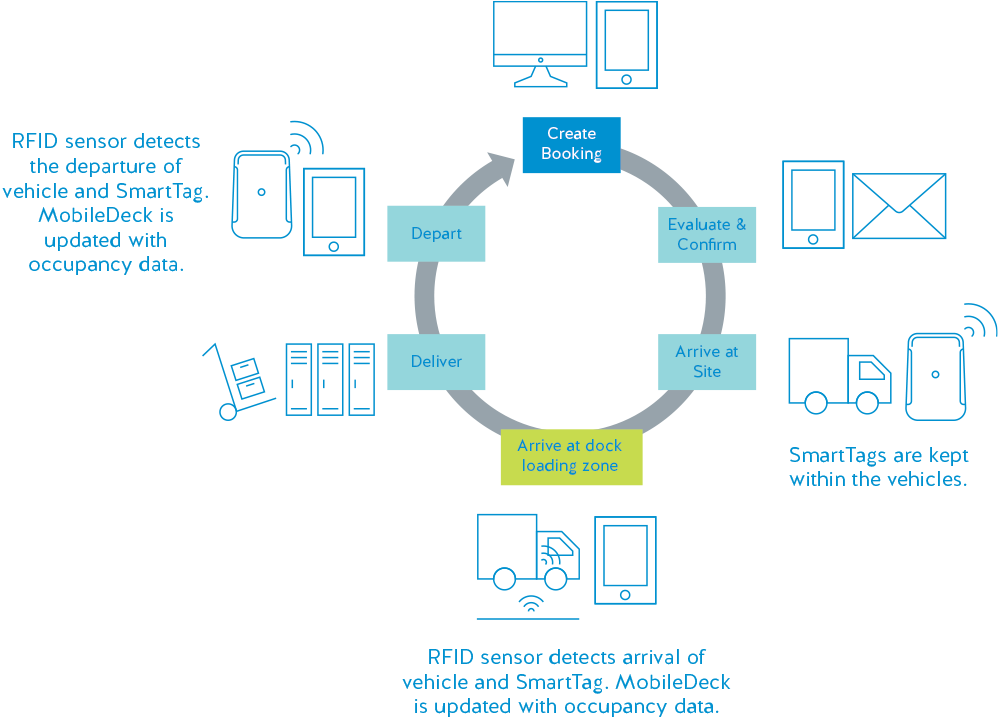
The warehouses have always been a vital hub in the flow of goods within a supply chain. Nevertheless, in today’s economic climate, they also need to serve as a key source of competitive advantage for logistics providers. The adoption of the Industry 4.0 paradigm will introduce remarkable changes in the way warehouse works these days. Especially, the introduction of ‘smart’ management throughout the proper adoption and implementation of Warehouse Management Systems (WMS) which will transform the warehouse activities into the future requirements of the inbound logistics according to the Industry 4.0 paradigm. The integration required within the different actors and stakeholders of the supply chain will guarantee a total coordination and alignment between all the value chain phases. Therefore, as an example, transports will be able to communicate their position and predicted arrival time to the intelligent warehouse management system, which will be able to select and prepare a docking slot, optimizing just-in-time and just-in-sequence delivery. Simultaneously, the RFID sensors will reveal what has been delivered, and send the track-and-trace data to the entire supply chain. The WMS will automatically attribute storage space according to the delivery specifics, and request the appropriate equipment to move the goods to the right location autonomously. Once pallets are moved to the assigned location, tags will transmit signals to the WMS to provide real-time visibility into inventory levels, which could prevent costly out-of-stock situations, as well as enhancing the management decision capability towards adjustments that might be needed to increase clients’ service level.
Smart Logistics – Transportation management systems
A transportation Management System (TMS) is part of supply chain management (SCM) centered on transportation logistics. A TMS enables interactions between an order management system (OMS) and distribution center (DC) or a warehouse. As TMS has matured, these systems have been called upon to help companies control and manage ever higher freight costs; integrate with other supply chain technologies (like Warehouse Management Systems and Global Trade Management Systems); and handle electronic communications with customers, trade partners, and carriers. As their breadth of offerings has expanded to incorporate these and other capabilities, TMS has become a popular choice for companies of all sizes and across all industries. With the massive use of IoT and the inevitable road to Industry 4.0, a TMS system is, for sure, an essential element in the concept of Logistics 4.0. Logistics 4.0 uses real-time and inline data to achieve more efficiency and effectiveness in a logistic process. A TMS system is important for a company to be able to use GPS technology to accurately locate its own vehicles while they’re on the road, monitor freight movement, negotiate with carriers, consolidate shipments, and use the platform’s advanced functionalities and interact with Intelligent Transportation Systems (ITS). TMS functionalities continue to expand every year, which in a near future it is expected to see more companies adopting these systems in an effort to improve overall transportation management and customer service. With the increased offers in cloud services and cloud computing, TMS cloud based is becoming the standard. The most important software houses are rapidly moving their TMS solutions to the cloud, thus reducing drastically the number of on premise installs on the future. TMS are redefining companies strategies as most recent TMS offer better end-to-end supply chain visibility, they are being adopted among small-to mid-sized companies, TMS increase the upper end of Return of Investment (ROI), with the increased use of mobile devices and services TMS solutions will be integrating smartphone applications that drivers can use to create ‘breadcrumb visibility’ of where specific trucks are at any given time.
IoT and TMS will play an increasingly important role in transportation and logistics industries. As more and more physical objects are equipped with bar codes, RFID tags or sensors, transportation and logistics companies can conduct real-time monitoring to the movement of physical objects from an origin to a destination across the entire supply chain including manufacturing, shipping, and distribution. IoT is also offering promising solutions to transform transportation systems and automobile services. As vehicles have increasingly powerful sensing, networking, communication, and data processing capabilities, IoT technologies can be used to enhance these capabilities and share under-utilized resources among vehicles in the parking space or on the road. For example, IoT technologies make it possible to track each vehicle’ existing location, monitor its movement, and predict its future location. A well-defined and configured TMS, interacting with IoT devices, which we call as “Smart TMS”, is a key point for increasing the decision-making quality of management and to make the SCM more and more flexible and efficient in a very near future, leading to a full Logistics 4.0 operation.
Smart Logistics – Intelligent transportation systems

Intelligent Transportation System (ITS) is a novel field that interoperates in different fields of transportation systems such as transportation management, control, infrastructure, operations, policies and control methods. ITS adopts new technologies like computing hardware, positioning system, sensor technologies, telecommunications, data processing, virtual operation and planning techniques. Since we are living in a global world, the ITS system becomes a vital part of it. The idea of virtual technologies integration is a novel issue in the transportation field and it plays a vital part to overcome the issues in global world. ITS’s are important for increasing safety and reliability, travel speeds, traffic flow and for reducing risks, accidents rate, carbon emissions and air pollution. An Intelligent Transportation System provides solutions for cooperation and reliable platform for transport. Electronic Toll Collection (ETC), Highway Data Collection (HDC), Traffic Management Systems (TMS), Vehicle Data Collection (VDC), Transit Signal Priority (TSP), Emergency Vehicle Pre-emption (EVP) are some applications of ITS. ITS is not limited for vehicular traffic, it also provides other services and can be implemented in navigation systems, air transport systems, water transport systems and rail systems. The most recent generation of ITS, generation 4.0, makes use of multimodal systems incorporating personal mobile devices, vehicles, infrastructure and information networks for system operations as well as personal contextual mobility solutions. ITS plays an important role with cooperative systems technologies, to support and enhance the logistic process and the effectiveness of the fleet to substantially improve the results of the transportation community, economically as well as in sustainability. An ITS using real time and inline data gathered through VANET Systems [3], sensor networks, drone points and business intelligence systems, will increase the decision-making quality of management and become more and more flexible and efficient in the near future, thus allowing to improve the efficiency of logistics through the convergence of Machine to Machine (M2M) communication and cooperative systems technologies. Thinking in Logistics 4.0, a fully operational ITS environment can be used for: intelligent truck parking and delivery areas management; multimodal cargo, i.e., supporting planning and synchronization between different transport modes during the various logistic operations; CO2 footprint estimation and monitoring; priority and speed advice, i.e., saving fuel consumption, reducing emissions and heavy vehicle presence in urban areas; eco-drive support, i.e., supporting truck drivers in adopting a more energy efficient driving style and therefore reducing fuel consumption and CO2 emissions.
Smart Logistics – Information security
The proliferation of the internet-based applications promoted by the emergence of cloud-based systems, the Internet of Things (IoT), Big Data, Industry 4.0, BYOD (Bring Your Own Device) and CYOD (Choose Your Own Device) trends have changed the way organizations conduct their businesses. Organizations are deeply interested in finding new technological initiatives at low operating cost, in order to offer better and innovative services and thus gain competitive advantage. However, with increasing reliance on technology to gain competitive advantage, information security is and has been one of the most critical and challenging requirements for conducting a successful business. In fact, the new technological solutions always carry vulnerabilities, which most of time reveal unexpected security risks . In this context, it is very important for organizations to develop efforts to ensure their ability to securely protect their information assets and IT infrastructure. The amount of data which organizations daily have to deal with, the increasing number of on-line transactions, the integration of new systems and their increased hypothetical potential third-party access, and on the other hand, the lack of computer security awareness are greater motivations not only to exploit software vulnerabilities but to exploit human vulnerabilities. In general, users tend to accept new technologies with complete disregard of their inherent security vulnerabilities, if they get sufficient benefits from them. Fostering and continuously encouraging a security culture and recognizing that all technological applications and systems have their inherent vulnerabilities and that people still are, and will always be the weakest link, will certainly assist organizations to achieve their adequate levels of security and thus becoming closer to their business goals. Moreover, monitoring and early detection also play an important role, as it enables organizations to react more quickly to events that are harder to find and understand, from the security management point of view. The rapid response to the security events and the establishment of preventive actions to manage security are starting to become an important competitive strategy to organizations. In this context, organizations should identify, implement, monitoring and evaluate the most effective set of controls, to provide an adequate level of security and to ensure their business continuity. Usually organizations proceed with identification and selection of the security controls according to their business needs and the associated security requirements. This security requirement should be clearly defined in the information security policy and the security policy dictates the set of controls that will provide the required protection. Additionally, to verify if the implemented controls meet the information security requirements, the evaluation and certification should be the following step. Actually, it has been noticed an increasing number of organizations seeking to obtain security certification. Certification enables organizations to comply with increasing demands from financial institutions and insurance companies for security audits. Moreover, it promotes trust in an organizations’ capacity to implement appropriate security controls to manage and protect confidential and sensitive client and business information. Additionally, the monitoring and evaluation of the implemented controls are crucial in order to find out if they are performing as expected, i.e., controls are in place, are designed appropriately, are operating effectively, and are monitored regularly, in an effort to reduce risk exposure.
Smart Logistics – Our message
We addressed some reflections regarding the most important dimensions required for a fully implementation of Logistics 4.0 paradigm, as well as the challenges to overcome these requirements in a proper way. Under the same principal statements of Industry 4.0, Logistics 4.0 encompass a range of technical components as Cyber-physical systems, software and human support. Thus, Logistics 4.0 paradigm can be summarized as the optimization of inbound and outbound logistics which must be supported by intelligent systems, embedded in software and databases from which relevant information is provided and shared though Internet of Things (IoT) systems, in order to achieve a major automation degree. Additionally logistics can be seen as a network where all processes can communicate with each other, as well as with humans for enhancing theirs analytical potentialities throughout the supply chain. Regarding the supply chain, the digital transformation and the use of intelligent and cooperative systems will make the supply chain smarter, more transparent and more efficient in every stage. There will be a particular focus in new models which will be more closely to individual customer needs, promoting a significantly increase of the decision making quality and become more and more flexible and efficient in the near future of Industry 4.0 and logistics 4.0.
How Industry 4.0 can address logistics challenges, opportunities
Supply chain executives from several diverse industries recently gathered at the 7th Annual Eurasian Supply Chain Congress to listen to a broad range of topics, all with a common theme: how do we improve the sustainability and competitiveness of the supply chain in Africa?
A recurring question emerged among the many speakers and topics: can technology be leveraged to address the challenges and opportunities inherent in the logistics industry? Industry 4.0 is commonly seen as an all-purpose response.
Industry 4.0 is a term that was coined a few years ago in a project in the high-tech strategy of the German government, to indicate the fourth industrial revolution – the interconnectedness of all aspects of manufacturing and distribution. It includes aspects such as, and amongst others, the internet of things (IoT), digitisation, mobile devices, Blockchain, big data, analytics and cloud computing.

The benefits are clear
From a logistics industry perspective, the real benefits of Industry 4.0 are clear.
With the volumes of data generated daily and significantly increased transparency, it is possible to anticipate demand, and so prepare more effectively, in turn improving inventory planning, warehousing fulfilment, and distribution. The efficiencies gained as well as the significant cost savings mean that the return on investment in many technology investments can be rapidly implemented and the tangible benefits enjoyed.
Another key benefit is improving communication between suppliers and clients. Customer service expectations have shifted, with customers demanding more real-time visibility over and above the basic expectations of right deliveries to the right place at the right time and in the right condition.
Across the logistics industry, an effective management of customer expectations will become not a competitive differentiator but a stake at the table. At its core, it is about the digitisation and integration of vertical and horizontal value chains.
Smart Logistics – Business basics
It may only be possible to take advantage of the benefits
afforded by technology if the business basics or foundations are in place. To
be successful in implementing technology to transform operations, organisations
need to take several aspects into consideration:
1. Proper planning is essential. Before embarking on any project, supply
chain executives need to be clear on the intended outcome of the implementation
and have measurable, clear objectives in place.
2. Initial and ongoing education is key to ensure sustained success. The
best-implemented projects can fail over time if managers don’t consider the need
for continual education as well as an understanding, and translation to
relevant stakeholders, of changing business priorities. Changing the
organisation to become a digital culture requires time and effort.
3. Understanding data is critical. One of the biggest
shifts in the application of Industry 4.0 is the wealth, quality and
availability of data generated. However, supply chain executives need both a
deep understanding of the data and the ability to act on it to bring about real
transformation in the organisation. A report is only as good as the insight
derived from it.
4. Choose the right technology partner. The technology itself is only one
aspect of the solution. It is critical that the solution partner has a deep
understanding of the supply chain and logistics industry and application of
relevant measures to ensure a solution doesn’t become shelf-ware. Both parties
need to invest in an ongoing relationship to ensure that the relevant solution
is implemented correctly, supported and maintained so that it retains relevancy
as the organisation itself transforms. The advanced connectivity and automation
of Industry 4.0 have the real potential to transform the logistics industry,
the technology is available now and is no longer just hype
However, investment in relevant technologies needs to be carefully thought out and planned, in order to gain the considerable advantages afforded by innovative solutions.
Blockchain can transform logistics and supply chain management in SA
While block chain in logistics is not fully matured, it holds huge potential and companies should seek to understand its functionality, value, and tangible rewards
Businesses the world over are still struggling to understand the opportunities and challenges presented by the next-generation technologies of the fourth industrial revolution (4IR), and SA is no exception. Although a lot has been written and spoken about the pioneering technological concepts underpinning the 4IR — artificial intelligence (AI), automation, robotics, the Internet of Things, 3D printing and block chain — there seems to be a slow adoption of these game-changing production tools by local manufacturing businesses.
This is partly due to the dearth of relevant skills, but largely due to poor understanding of potential derived benefits.
Nonetheless, the aforementioned ground-breaking industrial manufacturing concepts should be driven and propagated to a tipping point to ensure a common understanding of underlying dynamics and obtain relevant buy-in from local stakeholders and policy makers. Indeed, the technological developments could be instrumental in ensuring that manufacturing regains its mojo and its increased contribution towards the 5% GDP growth required in terms of the National Development Plan (NDP) to reduce poverty and inequality — including unemployment below 15% by 2030.
Despite its perceived challenges, the 4IR is rapidly gaining momentum globally since its inception in 2010 and is increasingly becoming a direction taken by most emerging markets. The news that US technology giant Google recently opened a first-of-its-kind AI research laboratory in Ghana to help deal with relevant high-tech challenges in Africa was refreshing. This is despite Africa being a laggard and playing catch up, with similar research centres already opened in the US, Europe and Asia.