What are Smart Contracts?
A smart contract is a computer protocol intended to digitally facilitate, verify, or enforce the negotiation or performance of a contract. Smart contracts allow the performance of credible transactions without third parties.
One of the most unique features of blockchain is its quality of acting as a decentralized which is shared between all the parties of the network thus, eliminating the involvement of middlemen or third-party intermediaries. This feature is particularly useful because it saves you from the chances of any process conflict and saves time too. Though Blockchains have their own set of issues that are yet to be resolved, they offer faster, cheaper and more efficient options as compared to the traditional systems. Due to this, even the banks and governmental organizations are turning to blockchains these days.
Smart contracts can be termed as the most utilized application of blockchain technology in the current times. The concept of smart contracts was introduced by Nick Szabo, a legal scholar, and cryptographer in the year 1994. He came to a conclusion that any decentralized ledger can be used as self-executable contracts which, later on, were termed as Smart Contracts. These digital contracts could be converted into codes and allowed to be run on a blockchain.

Though the idea of smart contracts came into existence long back, the current world that we live in works on paper-based contracts. Even if digital contracts are used, the involvement of a trusted third-party from the system cannot be eliminated. While we have defined a system of functioning with this method; we cannot say for sure if it is always smooth. The involvement of third-party might lead to security issues or fraudulent activities along with an increased transactional fee.
With the introduction of blockchain in the digital technology space, such issues can be addressed efficiently. A blockchain based system allows all the entities in the network to interact with each other in a distributed manner thus, eliminating the requirement of any trusted third-party. In simple terms, Blockchain is a technology that stores data on a distributed ledger. The stored data of records and transactions are available to all the parties in the network in real-time. Blockchain technology gained attention with the introduction of the Bitcoin, the first and most established cryptocurrency so far. Other than the application of cryptocurrency, Blockchain has evolved and its use cases are coming forward in different industries. Smart contracts are one of the most successful applications of the blockchain technology. Using smart contracts in place of traditional ones can reduce the transaction costs significantly. Ethereum is the most popular blockchain platform for creating smart contracts. It supports a feature called Turing-completeness that allows the creation of more customized smart contracts. Smart contracts can be applied in different industries and fields such as smart homes, e-commerce, real-estate and asset management etc.
A smart contract is a set of computer code between two or more parties that run on the top of a blockchain and constitutes of a set of rules which are agreed upon by the involved parties. Upon execution, if these set of pre-defined rules are met, the smart contract executes itself to produce the output. This piece of code allows decentralized automation by facilitating, verifying, and enforcing the conditions of an underlying agreement. Smart contracts allow you to exchange anything of value including money, shares, property etc, in a transparent manner eliminating the need for a middleman and keeping the system conflict-free.
In a normal world process for getting a court-registered document as a proof, you would need to go to a lawyer or notary first, give them money in turn of their services and wait till you get the document that you need. However, the scenario changes completely with smart contracts. When you run this process with smart contracts, you’d simply get the document of your need by paying just for that and this will be done without the involvement of any third-party such as the lawyer in this case. Moreover, smart contracts are not limited to only defining the rules around any agreement but they are also responsible for automatically executing those rules and obligations.
In other words, Smart contracts are automatically executable lines of code that are stored on a blockchain which contain predetermined rules. When these rules are met, these code executes on its own and provides the output. In the simplest form, smart contracts are programs that run according to the format that they’ve been set up by their creator. Smart contracts are most beneficial in business collaborations in which they are used to agree upon the decided terms set up by the consent of both the parties. This reduces the risk of fraud and as there is no third-party involved, the costs are reduced too.
To summarise, smart contracts usually work on a mechanism that involves digital assets along with multiple parties where the involved participants can automatically govern their assets. These assets and be deposited and redistributed among the participants according to the rules of the contract. Smart contracts have the potential to track real-time performance and save costs.
Smart Contracts Properties:
- Self-verifiable
- Self-executable
- Tamper Proof
How does a Smart Contract Work?
In order to understand how a smart contract works, let’s take an example where you wish to sell a property of your own. The process of selling properties demands a lot of paperwork as well as communication with multiple parties. Other than the communication complexity, it also involves the risk of frauds. In the current times, most of the people who want to deal in properties make their way ahead through real-estate agents. These agents are responsible for dealing with the paperwork and markets. They act as intermediaries in the overall process and work on negotiations and overseeing deal.
In such cases, you can’t rely on the person that you’re dealing with therefore, the agencies provide escrow services which transfer the funds from one party to the other. When the deal is finalized, you will have to pay both, the agent and the escrow service their commission in terms of the decided percentages. This leads to an extra loss of money and more risk on the seller’s end.
Enter Smart Contracts. Using smart contracts in such situations can result in more effectiveness by reducing the burden. Smart contracts are designed to work on condition-based principle (if this then that), which will resolve the ownership issue by transferring it to the buyer only when the monetary, as well as other conditions, are agreed upon. Moreover, when it comes to escrow services, smart contracts can replace those too.
Both money and the right of possession of the property can be stored in a distributed system which can be viewed by the involved parties in real-time. Since the money transfer will be witnessed by all the network participants, the chances of fraud are eliminated. Moreover, there’s no chance of an intermediary to be involved as the trust between parties is not an issue anymore. All the functions performed by the estate agent can be coded into the smart contract, thus, saving a considerable amount of money on both, buyer and seller end.
Why are Smart Contracts Need of the Day?
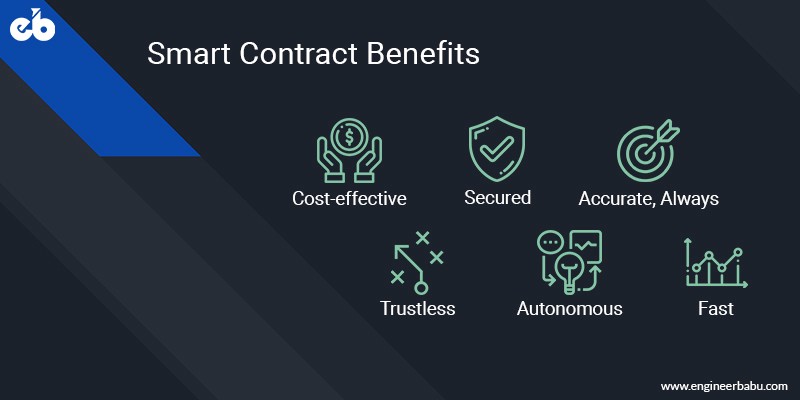
By applying smart contracts in our day to day life, we can make phenomenal changes as they offer multiple advantages over the traditional contracts. Smart contracts are more convenient and faster which make those acceptable for people to streamline their workflows.
They provide you with the right blend of security and ease of application as and when you need to exchange anything of value be it property, money or shared.
Eliminating the need for intermediaries make smart contracts even more attractive to apply in our lives. The usage of smart contracts is likely to gear up with the advancement of technology. Let us look at the benefits offered by smart contracts:
Transparency
One of the basic characteristics of blockchain technology which is also shared by smart contracts is transparency. As previously stated, smart contracts are filled with terms and conditions in absolute detail which are also checked by the parties involved in the agreement.
This eliminates the chance of dispute and issues at the later stages as the terms and conditions are thoroughly checked and put into place only when all the participants agree to those. This trait of smart contracts allows the involved parties to ensure transparency during transactions.
Moreover, need for precision in contract detailing keeps all the information open with everyone which ultimately resolves anything related to miscommunication issue. Therefore, with the aid of smart contracts, efficiency lost in communication gaps can be restored.
Time-efficient
In order to go ahead with any process involving documentation, it usually takes more than at least a couple of days. The delay in processes is due to a lot of intermediaries and unnecessary steps along the way. On the other hand, smart contracts are run through the aid of the internet as they are nothing but pieces of software code.
Therefore, the speed of completing transactions through smart codes is way too fast. Smart contracts can save hours or even days as compared to any traditional business process. Moreover, the time delay due to manual involvement is also eliminated.
Precision
A smart contract is coded in an explicitly detailed form. It requires to holds all the terms and conditions in it before it is finally put to work. Any condition that’s left out of the contract might result in an error while execution, therefore while creating smart contracts, all the conditions are put in the detailed form.
Due to this, the smart contract becomes a comprehensive agreement which when gets executed automatically, gets almost everything done. In the case of manual contracts, there are chances of errors as the person who is responsible for making a contract might miss one condition or the other. Moreover, there’s no way of even tracking it until the error is made. Therefore, smart contracts are a better alternative when it comes to achieving accuracy and precision.
Safety and Efficiency
Smart contracts with automated coding features are the safest options when it comes to data encrypted technology in the current times. Since they match the highest safety standards, the level of protection involved in them allows them to be secure to use for critical processes.
Moreover, since the smart contracts are so accurate and secure, their level of efficiency is way too high which generates more value in transactions.
Data Storage
Smart contracts are accurate and precise to the minutest level of the agreement. All the details of any transaction are stored on the contract and anyone among the involved parties can access it at any given time. Moreover, these transactions are stored on the blockchain in the form of future records. This is particularly helpful in terms of any dispute regarding the contract terms in the future.
Savings
Using smart contracts in place of traditional agreements can result in a lot of savings. First and foremost, as smart contracts only involve parties that are the part of the agreement; the need for middlemen is eliminated and the money involved in that is also saved.
All the lawyers, witnesses, and intermediaries have no role when smart contracts are used. Moreover, as stated earlier, smart contracts also save money as paper-based documents are not involved in any processes.
Trust
The properties of transparency and security make smart contract trustworthy in businesses. They obliterate any probability of manipulation as well as manual errors and establish confidence in their execution. Upon agreement on all the conditions, the contract automatically executes itself.
Another unique feature of these contracts may be their capability to significantly lessen the requirement of litigation and courts. Self-executing Smart Contracts allow parties to commit and bind by the conditions and rules written inside.
Paperless
As smart contracts are computer coded documents, the use of paper in the entire processes is eradicated. On one hand, this saves the cost while on the other, this is useful for companies globally as it helps them to save their bit of paper usage in terms of contracts and promotes their contribution towards the society.
Applications of Smart Contracts
Be it a new job or buying any new product, contractual agreements come into play as a proof for such things. However, the complex process of traditional paperwork and contracts involve high costs, third parties and chances of manual errors in such processes.
With digitization and technology moving ahead, we can make these processes more reliable and cost-effective with the help of smart contracts. The concept is to avoid any intermediaries and third-party systems and make the systems more effective and efficient. Smart contracts can be applied in different industries and sectors. Let’s have a look at some of them below:
Insurance
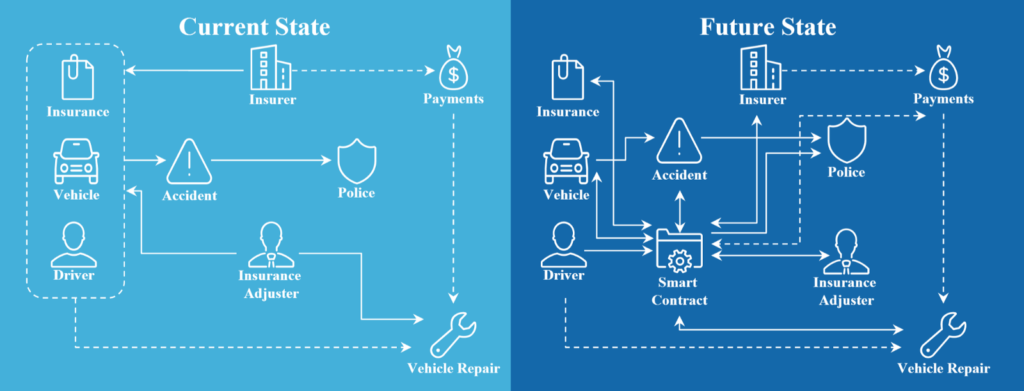
Lack of automation in insurance administration, claim processing can take a long time ranging from weeks to months. This becomes an issue for both the customers as well as the insurance companies as the customers are trapped in time constraints for their money. On the other hand, the companies have to face issues like unwanted administrative costs, dissatisfied customers, and inefficiency.
By using Smart contracts in such processes can result in simplifying and streamlining the processes by automatically triggering payment for a claim when certain conditions are met as per the client and company’s agreement. For example, in case of loss due to a natural disaster, smart contracts can be executed in a timely manner and people can claim their money and use them in time of need. Any specific details like the extent of loss due to damage can be kept on a blockchain and the amount of compensation can be decided accordingly.
Internet of Things
The IoT technology is being utilized to connect everyday devices to the internet in order to improve the interconnectivity of the systems in with the help of sensors. These devices can be connected to the blockchain system to keep a track of all the products and processes in the loop. For example, in a general scenario, you might receive a wrong order while shopping something online but with the combination of Blockchain and IoT, the product and its location can be tracked on every step of the way including the warehouse, transport, shipping to your doorstep. A fully-automated system will ensure that the right product gets delivered to the right person.
The sensors involved in the system create their own nodes on blockchain and with the help of smart contracts, the location and possession of the respective product can be traced. A smart contract keeps the location status updated all along the way till the product gets delivered. This helps in ensuring the correctness of the product from the initial shipment to delivery.
Employment Contracts
Employment contracts are another area where smart contracts are needed. If either of the party i.e. the employer or the employee fails to meet the set expectations, the terms of the agreement can be compromised. This leads to a lack of trust which is solved by smart contracts. By using a single smart contract for both the parties, the terms, and conditions can be made clear which would help improve fairness. These records could be anything such as salary amount, job responsibilities etc. Once these transactions are recorded on smart contracts, they can be looked into in case of any conflict. This will improve the employee-employer relationship.
Moreover, smart contracts can be utilized to make wage payment processing easier so that the desired employee receives the agreed amount in a specific time period. Also, in the case of temporary labor where the employer, employee and an agency is involved, smart contracts can be used to introduce transparency. This will prevent the agencies from interfering with the contract term of the employee once he/she is hired by the company. Any changes in terms can be detected with the aid of smart contracts.
Securing Copyrighted Content
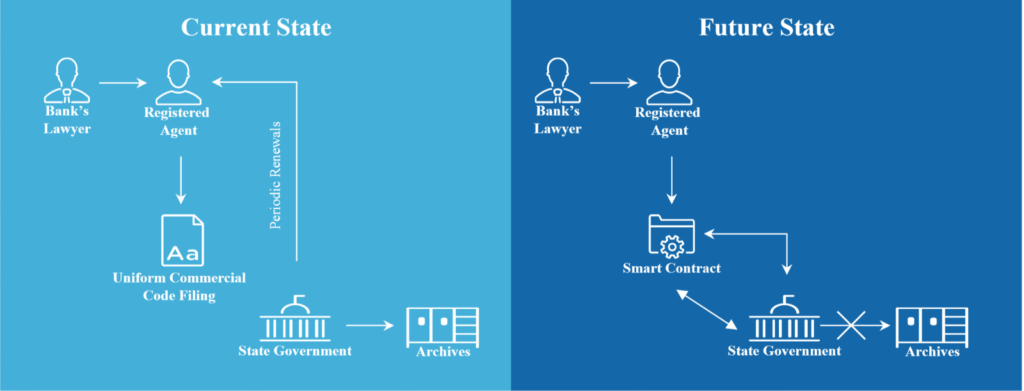
In the digital world of today, content is not limited to just words. It could be anything from a written document to a video to an audio clip. When a piece of content is released commercially, the owner of the content receives a royalty fee theoretically. However, the process of creation involves multiple parties and thus, all of them are liable for payments or royalty. In practical implication, this is not ensured as there is no defined way of clearing the confusion over entitlement. Smart contracts can resolve this by ensuring the royalties to the desired contributor by recording the ownership on a blockchain.
Supply Chain
Supply chain management involves the flow of goods and products from the initial stage to the final stage. Being a major part of many industries, proper functioning of a supply chain is crucial for businesses. Supply chain management is not a one person job to do and thus, there are different entities involved in it. Smart contracts in the supply chain can record ownership rights while the products are transferred through the supply chain. Everyone in the network can track the location of the product at any given time.
The final product can be checked at each stage throughout the delivery process until it reaches the end customer. If an item is lost in the process, smart contracts can be used to detect its location. Also, if any stakeholder fails to meet the contract terms, it would be transparent for the whole system to see. Smart contracts bring transparency to the overall supply chain system.
Smart contracts have certain advantages for many industry sectors such as, reducing overhead costs, providing transparency, and saving time. While they are more reliable, secure, efficient and trustworthy as compared to paper contracts, care needs to be taken to avoid the risks of code corruption and as businesses move forward and accept digital processes, risk awareness is integral too.
Smart Ostrich & Smart Contracts – Birds of a feather
The potential of smart contracts cannot be limited. They can be used for small regular agreements as well as contracts for governments and enterprises too. They allow traders and buyers to track their purchase back in the supply chain which increases trust.
While third-parties like lawyers, government bodies etc. make a hole in our pockets in the form of fees for making agreements; smart contracts save this money by eliminating the need for such intermediaries. When it comes to using smart contracts, all we need to do is check the code before the execution, everything after that will be done in an electronic way. Smart contracts provide us with an opportunity to make our routine transactions and processes more streamlined and automated.
The base of smart contracts are interfaces, business rules, and data. With evolving technology, smart contracts will also need to be updated for eliminating any compatibility issues with operating systems and perform their directed functions correctly. While smart contracts are still in their developing phase, they might face certain vulnerability attacks. In order to make smart contracts a part of our day to day life, both, cybersecurity practices as well as the platforms to create smart contracts need to be updated from time to time.
What are Smart Contracts?
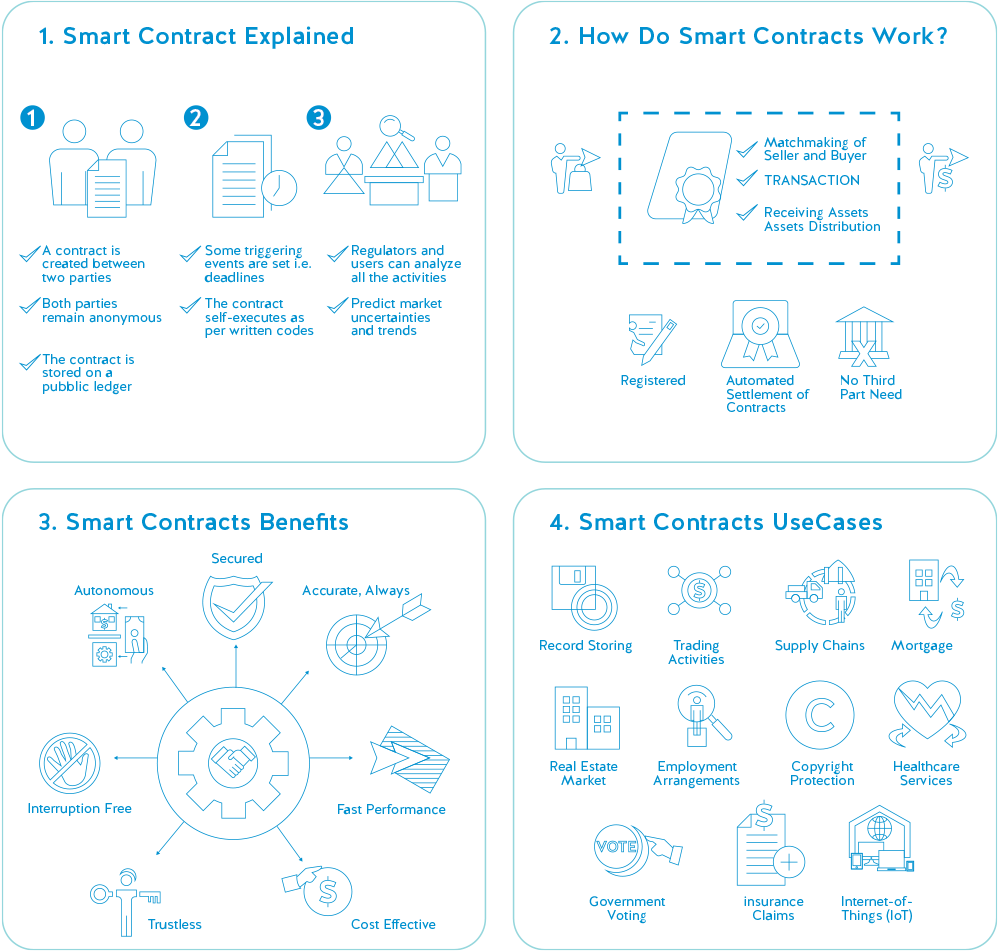
Smart contracts help you exchange money, property, shares, or anything of value in a transparent, conflict-free way while avoiding the services of a middleman.
The best way to describe smart contracts is to compare the technology to a vending machine. Ordinarily, you would go to a lawyer or a notary, pay them, and wait while you get the document. With smart contracts, you simply drop a bitcoin into the vending machine (i.e. ledger), and your escrow, driver’s license, or whatever drops into your account. More so, smart contracts not only define the rules and penalties around an agreement in the same way that a traditional contract does, but also automatically enforce those obligations. If you are looking for a more detailed walkthrough of smart contracts please check out our blockchain courses on smart contracts.
One of the best things about the blockchain is that, because it is a decentralized system that exists between all permitted parties, there’s no need to pay intermediaries (Middlemen) and it saves you time and conflict. Blockchains have their problems, but they are rated, undeniably, faster, cheaper, and more secure than traditional systems, which is why banks and governments are turning to them.

Smart Ostrich, Smart Contracts & Ethereum block chain?
Beyond Bitcoin & first generation decentralized applications
Although commonly associated with Bitcoin, blockchain technology has many other applications that go way beyond digital currencies. In fact, Bitcoin is only one of several hundred applications that use blockchain technology today.
Until relatively recently, building blockchain applications has required a complex background in coding, cryptography, mathematics as well as significant resources. But times have changed. Previously unimagined applications, from electronic voting & digitally recorded property assets to regulatory compliance & trading are now actively being developed and deployed faster than ever before. By providing developers with the tools to build decentralized applications, Ethereum is making all of this possible.
At its simplest, Ethereum is an open software platform based on blockchain technology that enables developers to build and deploy decentralized applications.
Is Ethereum similar to Bitcoin? Well, sort of, but not really.
Like Bitcoin, Ethereum is a distributed public blockchain network. Although there are some significant technical differences between the two, the most important distinction to note is that Bitcoin and Ethereum differ substantially in purpose and capability. Bitcoin offers one particular application of blockchain technology, a peer to peer electronic cash system that enables online Bitcoin payments. While the Bitcoin blockchain is used to track ownership of digital currency (bitcoins), Ethereum focuses on running the programming code of any decentralized application.
In the Ethereum blockchain, instead of mining for bitcoin, miners work to earn Ether, a type of crypto token that fuels the network. Beyond a tradeable cryptocurrency, Ether is also used by application developers to pay for transaction fees and services on the Ethereum network.
There is a second type of token that is used to pay miners fees for including transactions in their block, it is called gas, and every smart contract execution requires a certain amount of gas to be sent along with it to entice miners to put it in the block chain.
What is an Ethereum smart contract?
Smart contract is just a phrase used to describe a computer code that can facilitate the exchange of money, content, property, shares, or anything of value. When running on the block chain a smart contract becomes like a self-operating computer program that automatically executes when specific conditions are met. Because smart contracts run on the block chain, they run exactly as programmed without any possibility of censorship, downtime, fraud or third-party interference. While all blockchains have the ability to process code, most are severely limited. Ethereum is different. Rather than giving a set of limited operations, Ethereum allows developers to create whatever operations they want. This means developers can build thousands of different applications that go way beyond anything we have seen before.
The Ethereum Virtual Machine
Before the creation of Ethereum, blockchain applications were designed to do a very limited set of operations. Bitcoin and other cryptocurrencies, for example, were developed exclusively to operate as peer-to-peer digital currencies.
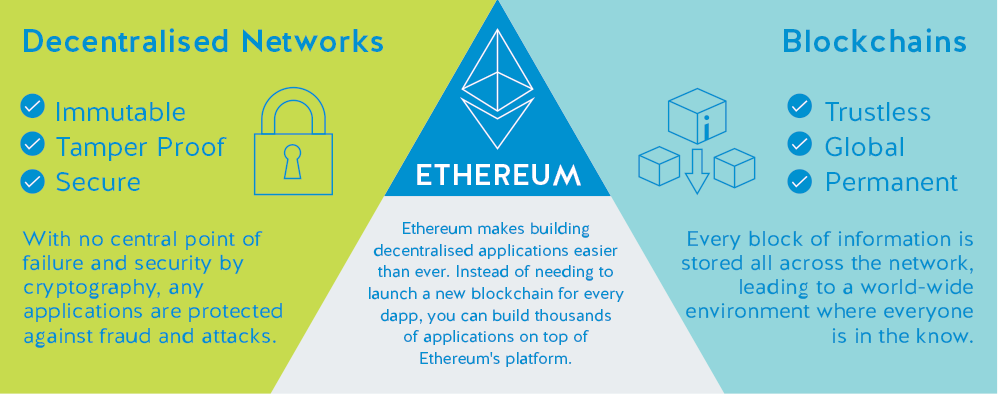
Developers faced a problem. Either expand the set of functions offered by Bitcoin and other types of applications, which is very complicated and time-consuming, or develop a new blockchain application and an entirely new platform as well. Recognizing this predicament, Ethereum’s developed a new approach. Ethereum’s core innovation, the Ethereum Virtual Machine (EVM) is a Turing complete software that runs on the Ethereum network. It enables anyone to run any program, regardless of the programming language given enough time and memory. The Ethereum Virtual Machine makes the process of creating blockchain applications much easier and efficient than ever before. Instead of having to build an entirely original blockchain for each new application, Ethereum enables the development of potentially thousands of different applications all on one platform.
What is Ethereum And what can it be used for?
Ethereum enables developers to build and deploy decentralized applications. A decentralized application or Dapp serve some particular purpose to its users. Bitcoin, for example, is a Dapp that provides its users with a peer to peer electronic cash system that enables online Bitcoin payments. Because decentralized applications are made up of code that runs on a blockchain network, they are not controlled by any individual or central entity. Any services that are centralized can be decentralized using Ethereum. Think about all the intermediary services that exist across hundreds of different industries. From obvious services like loans provided by banks to intermediary services rarely thought about by most people like title registries, voting systems, regulatory compliance and much more.
Ethereum can also be used to build Decentralized Autonomous Organizations (DAO). A DAO is a fully autonomous, decentralized organization with no single leader. DAO’s are run by programming code, on a collection of smart contracts written on the Ethereum blockchain. The code is designed to replace the rules and structure of a traditional organization, eliminating the need for people and centralized control. A DAO is owned by everyone who purchases tokens, but instead of each token equating to equity shares & ownership, tokens act as contributions that give people voting rights.
A DAO consists of one or more contracts and could be funded by a group of like-minded individuals. A DAO operates completely transparently and completely independently of any human intervention, including its original creators. A DAO will stay on the network as long as it covers its survival costs and provides a useful service to its customer base. Ethereum is also being used as a platform to launch other cryptocurrencies. Because of the ERC20 token standard defined by the Ethereum Foundation, other developers can issue their own versions of this token and raise funds with an initial coin offering (ICO). In this fundraising strategy, the issuers of the token set an amount they want to raise, offer it in a crowd sale, and receive Ether in exchange. Billions of dollars have been raised by ICOs on the Ethereum platform in the last two years, and one of the most valuable cryptocurrencies in the world, EOS, is an ERC20 token.
Ethereum has recently created a new standard called the ERC721 token for tracking unique digital assets. One of the biggest use cases currently for such tokens is digital collectibles, as the infrastructure allows for people to prove ownership of scarce digital goods. Many games are currently being built using this technology, such as the overnight hit CryptoKitties, a game where you can collect and breed digital cats.
What are the benefits of a decentralized Ethereum Platform?
Because decentralized applications run on the blockchain, they benefit from all of its properties.
- Immutability – A third party cannot make any changes to data.
- Corruption & tamper proof – Apps are based on a network formed around the principle of consensus, making censorship impossible.
- Secure – With no central point of failure and secured using cryptography, applications are well protected against hacking attacks and fraudulent activities.
- Zero downtime – Apps never go down and can never be switched off.
Most significant companies will run business processes on their private blockchains.
- Private blockchains: Within two years, major companies will conduct several business processes on their own private, permissioned corporate blockchains. Employees, customers, vendors, and service providers at each company will be able to securely access that company’s private blockchain via strong cryptographically authenticated transactions.
- Consortia blockchains: In two years, many companies will have started to build bottom-up consortia blockchains with a small number of counterparties in their ecosystem collaborating on a small number of use cases to share trusted source-of-truth infrastructure, supply or value chains.
- Business use of public blockchains: Some companies will employ public Ethereum with their use cases that employ the same stack of blockchain components that they have purchased or built for their private Ethereum-based implementations.